News for all
Uzbekistan plans to double uranium production by 2030
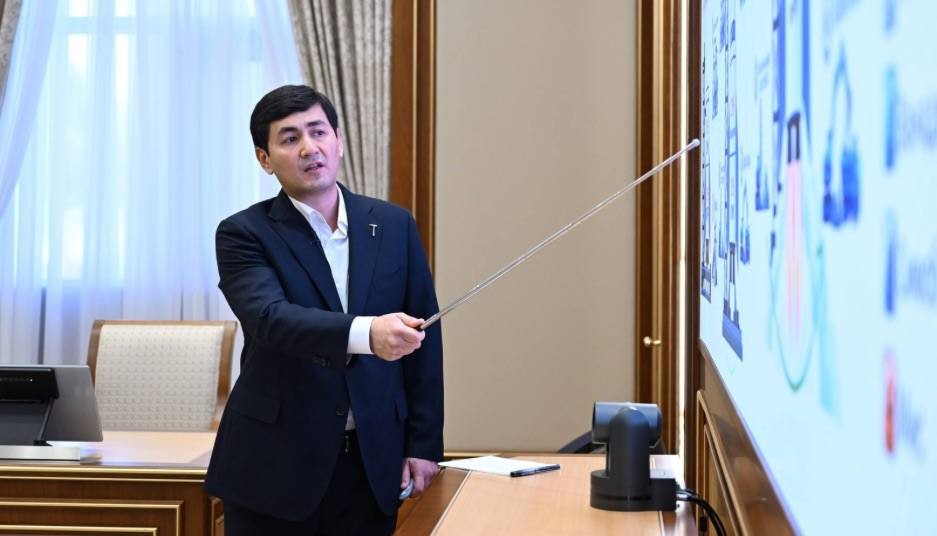
President Shavkat Mirziyoyev reviewed plans for the development of the enterprises “Navoiuran” and “Uzbek Technological Metals Combine.” This was reported by the presidential press service.
The presentation outlined the development prospects of the “Uzbek Technological Metals Combine.” The enterprise intends to build a complete production chain — from geological exploration and raw material extraction to enrichment, deep processing, and the production of finished goods.
By the end of 2026, it is planned to launch 12 investment projects, expand the range of localized products, and increase the output of high-purity selenium and tellurium.
At present, the combine has mastered the production of five types of critical raw materials: tungsten, molybdenum, selenium, tellurium, and rhenium. In the future, it is planned to establish the production of 11 more types of products, including nickel, cobalt, graphite, antimony, tin, manganese, platinum, vanadium, mercury, and copper.
According to the presented plans, by 2030 the production volume of 16 types of critical raw materials should exceed $2.7 billion.
Special attention was given to projects for the deep processing of tungsten. To implement them, it is planned to attract $1.1 billion in investment. By 2030, production volume in this area is planned to be brought to nearly $2.2 billion.
Opportunities were also considered for developing new deposits with reserves of rare and rare-earth elements, expanding the enterprise’s resource base, and accelerating investment projects.
The second part of the presentation was devoted to the development of “Navoiuran.” According to the enterprise, global demand for uranium raw materials has increased by 15–20% in recent years. By 2030, it is expected to grow by another 28%.
In this regard, it is planned to expand geological exploration and technological drilling, develop production infrastructure, and introduce additional sorption units. Within the framework of these measures, the creation of 250 new jobs is envisaged.
Issues of supplying production with chemical reagents were also considered separately. For this purpose, it is planned to strengthen cooperation with domestic industrial enterprises and increase supplies of technical sulfur, sulfate acid, and nitric acid.
In addition, the task has been set to expand the use of alternative technologies. By 2030, the share of reagents that make it possible to replace sulfuric acid in production processes is intended to be brought to 40%.
As a result of the implementation of the planned projects, annual uranium production is planned to increase from 7.5 thousand tons in 2026 to 15 thousand tons by 2030. Proven reserves, in turn, are expected to grow to 200 thousand tons.
Following the presentation, the responsible agencies were instructed to ensure the timely launch of new production facilities, strengthen the mineral resource base of the enterprises, increase the output of high value-added products, and expand exports.
Source
